
Explainer
An iPhone Incell LCD screen is a replacement display that builds the touch sensor into the LCD itself. It is a construction method, not a brand, and not an original Apple part. Shops use the word because it is cheaper to make than the kind of panel most recent iPhones were designed around — not because it is the same thing with a different label.
A way of building a screen so the layer you touch is part of the LCD, rather than a separate digitizer glued on top. On the high street, “Incell” almost always means an aftermarket LCD replacement. Quality still varies by manufacturer and grade.
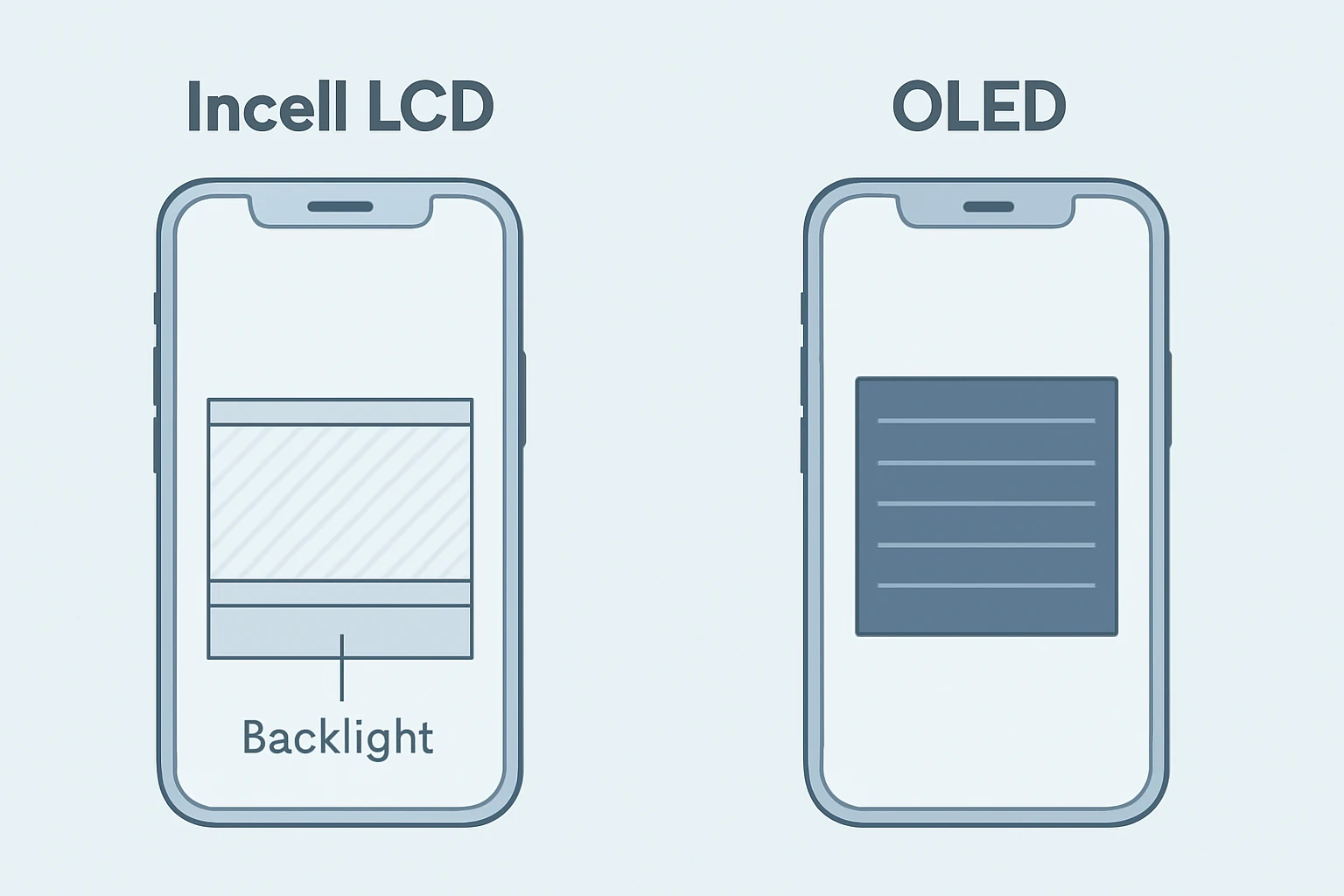
What Incell construction actually means
On many older aftermarket LCDs, the glass you press and the layer that draws the picture are two parts laminated together. That stack is thicker, and the join between the layers is a common place for cheaper units to feel slightly “off” — a little less crisp, or a little less even in colour.
Incell puts the touch-sensitive layer inside the LCD. The practical point is simple: fewer separate sheets in the stack. That is why aftermarket makers use it. It is cheaper and slimmer than the older two-part LCD, and it is still far cheaper than OLED. The word does not name a factory, a warranty, or a quality grade. Two screens both labelled Incell can differ in brightness, tint, and how they sit in the frame.
An LCD needs a backlight that stays on behind the picture. OLED pixels make their own light, so unused areas can go fully dark. That construction difference — not the shop’s wording — is why blacks, outdoor brightness and battery use are not the same, and why the prices diverge.
What differences might you actually notice?
You may notice less brightness outdoors, and less “true black” in dark scenes, because the backlight is still there. Colour can look a little flatter or slightly shifted, depending on the grade. Touch is often fine on a decent unit, and usually better than the older laminated aftermarket LCDs Incell replaced — but very cheap parts can still ghost, drift, or miss a corner.
Thickness is the quieter change. Incell is slimmer than those older two-part LCDs, which is why it can sit more neatly in the housing. It is still not as thin as OLED. Battery use is typically a little higher than OLED because the backlight does not switch off pixel by pixel. None of this means every Incell looks poor. It means the construction sets a ceiling, and the particular part you are offered sits somewhere under that ceiling.
How Incell differs from OLED — and from an original screen
Apple’s own recent iPhones use OLED. Aftermarket OLED also exists. So “OLED” on a quote is not automatically “original Apple”, and “Incell” is not a synonym for OLED. Aftermarket means a part made for the repair market rather than supplied as a new Apple assembly. Independent shops generally cannot fit a brand-new Apple-made display the way an Apple Store can. What they can fit is usually one of three things:
- an aftermarket Incell LCD
- an aftermarket OLED
- a refurbished original assembly taken from another phone
Those are not interchangeable. A high-grade aftermarket OLED can look closer to what the phone was designed with. A refurbished original is a used genuine assembly — still not a new Apple part, and still dependent on the condition of that particular unit. An Incell LCD is the budget construction. Treat the invoice as a description of which of those three you are buying, not as a promise that all “quality screens” are the same.
| What you are comparing | Aftermarket Incell LCD | Aftermarket OLED | Refurbished original assembly |
|---|---|---|---|
| What it is | LCD with the touch layer built in | Aftermarket panel that emits its own light | A used genuine assembly from another phone |
| Picture | Usable; often dimmer, less true black. Grade varies. | Usually brighter and more contrasty. Grade still varies. | Closest to the original design, if that unit is in good condition |
| Touch | Often fine on a decent unit; weak on very cheap ones | Usually excellent on a decent unit | As the original assembly allows |
| Power | Backlight stays on | Pixels make their own light | As the original design |
| Cost | Lowest of the three | Higher | Often highest, and stock-dependent |
| A reasonable fit when | The phone is older, a spare, a child’s handset, or about to be sold | You want the phone to look closer to how it did, and will pay for that | Matching the original construction matters more than the lowest quote |
The table is a summary, not a substitute for seeing the part. Manufacturers and grades are not identical. “Incell” or “OLED” on a box does not freeze the quality.
Is an Incell screen an original Apple screen?
No. Incell, as used in repair quotes, is an aftermarket construction. Calling it original because the touch layer is built in is a category error. Original-spec usually means a panel taken from another genuine assembly, or a part that matches what Apple fitted — not a cheaper LCD stack with a technical-sounding name.
If a quote uses “Incell” and “original” in the same breath, ask which one they mean. The useful distinction is construction and origin. The confidence of the label is not evidence.
When is an Incell screen a sensible choice?
It can be entirely reasonable. The decision changes with how you use the phone, how old it is, and how close the quote sits to the next grade up.
Incell is a sensible choice when the handset is already old, when a better OLED would cost a large fraction of replacing the phone, or when the phone is a spare, a child’s phone, or about to be sold on. In those cases you are choosing a cheaper picture on purpose.
OLED, or a refurbished original, is the better match when you care about the phone looking as it did, you use it in bright light, or the Incell quote has crept close to OLED money. Very cheap Incell units can show tint, weak touch, or a poor fit. That is a quality-of-part problem, not a reason to treat every Incell as a trap — and not a reason to assume an expensive screen is automatically better either.
There is no universal winner. Cheap is not always poor. Expensive is not always necessary. Genuine Apple is not always available, and it is not always what you need. What changes the decision is the phone in your hand, the construction you are actually being offered, and whether the price matches that construction.
Ask which construction you are being offered — Incell LCD, aftermarket OLED, or a refurbished original. Ask whether you can see a sample of that grade, not a photograph of a different one. Ask what the price would be for the next grade up, so you can tell whether you are choosing Incell or merely being given it. Honesty about that choice is worth more than the word on the box.